Roads · stops · junctions · waterways

Every bus. Every plate. Every rule. Seen.

TransitOne puts Ghana's fleets on one live screen and catches what goes wrong on the road: overloading, red lights, speeding, missing papers. The owner knows the same night, not weeks later when the fine arrives.

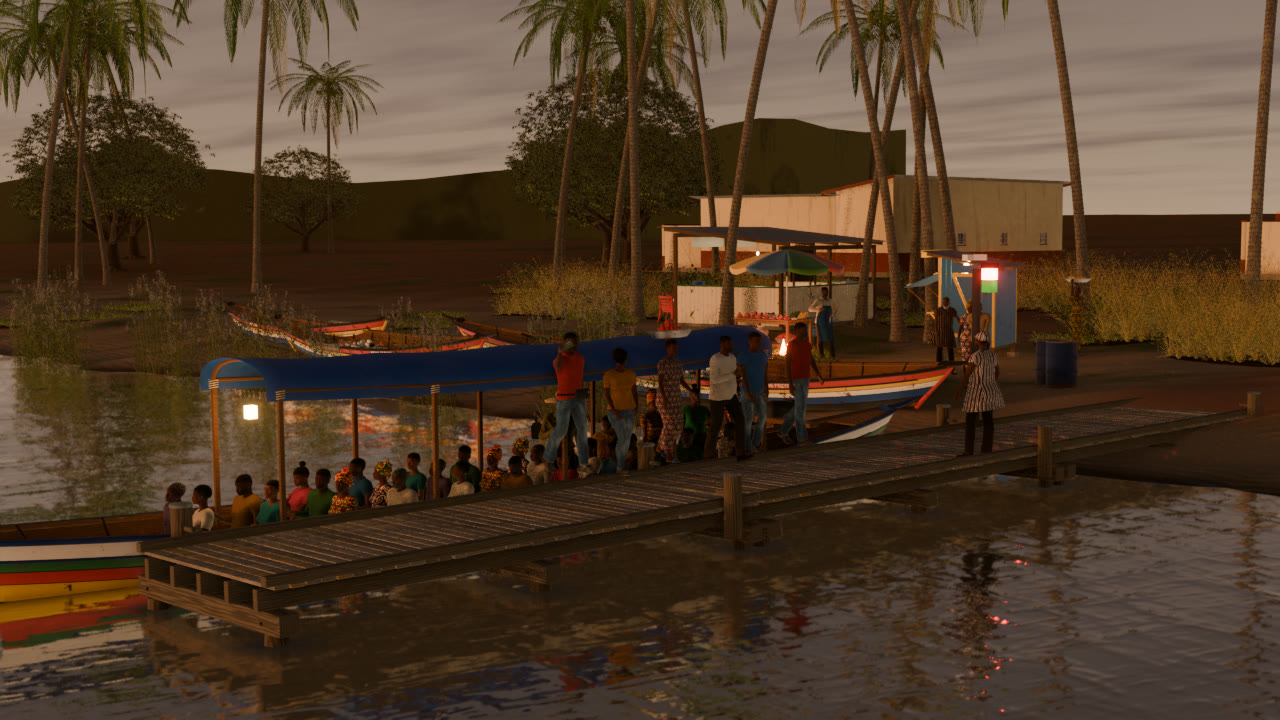
Concept film · simulated Rendered scenes from our own 3D model library. People, plates and operators are made up; the product is in design.

10 sbetween position reports for every moving vehicle
< 10 sfrom a stolen-plate read to a named officer's alert
3ways to pay: app, USSD on any phone, or a tap card
0faces recognised. The cameras count and protect; they don't identify

Design targets From the TransitOne requirements, not results from a live fleet.

One night on Ghana's roads

Six moments that usually go unseen

8 people die on Ghana's roads every day, and crashes peak between 6 and 8 pm (NRSA, 2025). Follow one trotro, one coach and one boat through a night. Pick a moment to play it in the film.

Concept scenes Sources for the figures: NRSA via GNA (July 2025) and the Ghanaian Times (January 2026); Ghana Maritime Authority via Graphic Online (October 2025).

One live map

Every bus, truck and ferry on one screen

Ghana moves on informal fleets that nobody can see. TransitOne tracks them, checks road and navigation rules, and puts operators, regulators and passengers on the same picture.

  • Buses and trotros, trucks, taxis and fleet cars, ferries and canoes
  • Keeps working through dead zones and back-fills up to 72 hours
  • One control room for road and water
Concept · simulated
Why TransitOne

Operators, passengers and regulators all work blind

Trotros, taxis, intercity coaches and haulage trucks carry the country.

No live view

Operators can't see where vehicles are, how drivers drive, or when a bus will actually arrive.

Manual enforcement

Speeding, red lights, overloading and route rules are enforced by hand, and unevenly.

Cash leaks

Cash fares leak revenue, and passengers get no reliable ticket, receipt or ETA.

Unsafe crossings

On Volta Lake: overloading, no manifests, submerged stumps, night travel and slow rescue.

The platform

One core, five things it does

The same identity, map, rules engine, alerting and ticketing run every module, so buses, trucks and boats sit on one platform and one control room.

01 · Track

Live tracking for every fleet

A telematics unit in each bus, taxi and truck reports position every 10 seconds and keeps working through dead zones.

  • Live map by fleet, route and vehicle type, with trip replay
  • Driver login per trip, so events belong to the driver
  • Trucks: load, cargo door and cold-chain temperature; banned roads and hours
  • Private cars only by opt-in: fleet cars, ride-hailing, insurance
Operator console · Circle–MadinaConcept
Vehicles live
148 / 150
ETAs within 2 min
87%
Speeding per 1,000 km
3.1
Fares paid digitally
64%
02 · Road rules

Safer driving, fairly scored

A rules engine checks every trip against posted speed limits, routes, driving hours and truck restrictions, and scores drivers 0–100. Confirmed violations go to a person for review before any penalty.

  • Speeding by road segment, harsh braking and cornering
  • Off-route, skipped stops, driving-hours limits
  • In-cab alert for speeding and fatigue (phone use, eyes closed, no seatbelt)
  • Every case shows the rule version that applied, and the driver can dispute it in the app
Driver scorecard · this weekConcept
Score
82 / 100
Over the limit
41 s at 104 km/h
Harsh braking
1
Driving hours
within limit
Case review
a person, before any penalty
03 · Passenger overwatch

Eyes on board and at the stop

Two to four cameras per bus and a camera at priority stops turn video into events on the spot: boarding counts, overcrowding, a fall, a fight, smoke, a door open while moving. A person in the control room decides what to do.

  • Live occupancy against licensed capacity, overcrowding alerts
  • Panic button for driver and passengers, with live video to the control room
  • Smart stops: live ETA display, waiting counts, a help point, solar where power fails
  • Video stays on the device for 7 days unless an event pulls a clip; faces blurred in exports
On board · trotro GT 4821-08Concept
Occupancy
19 of 15 seats
Faces
blurred on the device
Sent to the cloud
the count only
Panic button
armed
04 · Junctions

Plate reading and vehicle follow

At priority junctions, an infrared plate camera and an overview camera per approach read Ghana plates and spot red-light, stop-line, wrong-way and bus-lane violations at the edge. Every read becomes an evidence package an officer can stand behind.

  • Reads regional, commercial, government, diplomatic and motorbike plates, even dirty ones
  • Stolen, wanted or unroadworthy plates alert a named officer in under 10 seconds
  • Vehicle follow chains sightings across junctions, and shows the gaps honestly
  • Every search needs a case number and is logged
Junction camera · eastboundConcept
Plate read
GT 4821-08
Signal
1.8 s on red when crossed
Evidence
2 photos · clip · rule version
Next step
officer review
05 · Tickets for everyone

One ticket, any phone

One account works across operators and modes. Pay with mobile money or a card in the app; buy by USSD on a basic phone; or tap a reloadable card topped up with cash at agents.

  • Single, return, day, weekly and monthly passes; student and senior fares; intercity seats
  • QR or tap validation on the bus that works offline
  • Journey planner with live ETAs, share-my-trip and SOS
  • Daily revenue split to each operator, checked against boarding counts
Passenger app · Circle → MadinaConcept
M2 · Bus 214
4 min
Seats free
18
Day pass
valid until 23:59
USSD menu
1 Buy · 2 Next bus · 3 Top up
Languages
English, Twi, Ga, Ewe, Hausa
AI at the edge

Video stays where it's filmed

Each camera's AI runs on a small computer beside it. Only events, counts, plate reads and short evidence clips travel to the cloud, which keeps data costs low and raw footage off the network.

Vehicle unit

GPS, motion, offline buffer

position every 10 s

In-bus edge

2–4 cameras, AI module

counts · events

Smart stop

Camera, display, solar

waiting counts · ETAs

Junction

Plate and overview cameras

plate reads · cases

Platform

Map, rules, tickets, control room

decisions by people
TransitOne Marine

The same platform on Volta Lake and the coast

About 70% of the road platform carries over: tracking, rules, alerts, overwatch, ticketing and the control room. What's new is how boats connect and what counts as a rule on water.

Safety mesh for everyone

$40–80 canoe beacons with GPS, SOS and solar talk over a LoRa mesh of relay buoys and shore gateways, 5–10 km a hop. It carries position, SOS, short text and hazard alerts, and keeps working offline.

Broadband where it pays

Satellite Wi-Fi on ferries and patrol boats, and LTE from high shore masts (15–30 km over water) for anyone with a phone. AIS brings in commercial ships.

Search and rescue

An SOS sends the last known position; drift prediction draws the search area and routes it to the nearest rescue detachment.

Safer departures

Boarding counts against the load line, life-jacket checks, digital manifests, weather go/no-go per landing site, and a live hazard map of stump fields and shallows.

Later Marine follows the road platform; costs are planning estimates in US dollars.

Straight answers

What it does, and what it won't

TransitOne detects, alerts, advises and supports a response. People decide and act.

Does

  • Live tracking of every enrolled vehicle and beaconed boat
  • Rule checks, driver scorecards and evidence packages
  • Passenger counts, safety events and panic buttons
  • Plate reads and watchlist alerts at camera junctions
  • SOS, drift prediction and search coordination

With limits

  • Vehicle follow sees junctions with cameras, not the roads between
  • Hidden or fake plates narrow to candidates, not a match
  • Thermal finds canoes at night only at about 1–5 km
  • Satellites find larger vessels, not canoes, and not in real time

Won't

  • Recognise faces or identify passengers
  • Issue fines without a person reviewing the evidence
  • Steer, stop or remotely control any vehicle or boat
  • Track private cars without consent
  • Treat an anomaly score as proof
Governance built in

Evidence a court can trust, privacy people can trust

Cameras, plate reads and location history are personal data under Ghana's Data Protection Act, 2012 (Act 843). The guardrails are part of the product.

No face recognition

Faces are blurred in any exported clip unless released under a documented legal request.

A person reviews every case

Drivers and owners see the evidence and can appeal before any penalty.

Every search is logged

An immutable audit log of searches, video pulls and exports, reviewed monthly by an independent auditor.

Short, fixed retention

Raw video 7 days on the device; plate reads with no hit 30 days; case evidence until the case closes.

Data stays in Ghana

Hosted in Ghana or an agreed jurisdiction, encrypted in transit and at rest; registered with the Data Protection Commission.

Public by default

Signs at camera sites, watchlists only from authorised agencies, and a published transparency report.

The pilot

Start with one corridor and one crossing

Twelve-month targets, measured against a baseline taken before launch.

≥ 95%of the enrolled fleet reporting live
−30%speeding events per 1,000 km
−40%red-light violations at camera junctions
≥ 60%of fares paid digitally on pilot routes
± 2 minbus ETAs for 85% of predictions
< 60 sfrom incident alert to operator response
≥ 95%plate-read accuracy by day (90% at night)
< 5%of reviewed cases overturned
Road · one busy Accra corridor

100 buses, 50 trucks, 20 stops, 10 junctions

$2.5–3.5M over 12 months
  • Telematics, 150 vehicles~$30k + $15k/yr
  • In-bus AI kits, 100 buses~$250k
  • Smart stops, 20~$230k
  • Camera junctions, 10~$750k
  • Validators and control room~$165k
  • Platform build, 12 months~$1.2–1.8M
Water · one Volta crossing

Yeji–Mankango

$100–250k all in
  • Shore LoRa gateways, 1–2$3–10k
  • Relay or hub buoys, 3–6$30–150k
  • Ferry edge boxes$10–30k
  • Canoe beacons, 300$12–24k
  • Landing-site cameras$15–30k
Months 0–6

Track and ticket

Telematics, driver scores, the operator console, the ticket app with mobile money and USSD, live ETAs, in-bus recording.

Gate: 95% fleet live, 30% digital fares
Months 6–12

Edge AI safety

In-bus AI, smart stops, the rules engine and the human review queue. The Volta crossing pilot starts here.

Gate: alerts under 60 s, agreed false-alarm rate
Months 12–24

Junctions and enforcement

Plate and red-light cameras, watchlists, vehicle follow and case export, once the legal agreements are signed.

Gate: plate accuracy met, data-sharing signed

Planning estimates Pilot targets and costs in US dollars, not vendor quotes.

Who it's for

Operators, government, passengers and borders

Operators and unions

Bus companies, trotro union branches and haulage firms see every vehicle, fuel and revenue, driver scorecards and maintenance alerts.

Monthly subscription per vehicle

Government and cities

Assemblies, road safety and traffic agencies, maritime and disaster agencies get the camera layer, enforcement cases and planning data.

Contract for cameras, enforcement and analytics

Passengers

Commuters, students and intercity travellers buy tickets, see when the bus comes and feel safer on board and at stops.

Free app · a small fee on digital fares

Ports and border posts Roadmap

The same tracking and plate reading at air, sea and land entry points: cargo and passenger flow and clearance tracking, for faster, safer crossings.

Scoped with customs and immigration

Bring TransitOne to your corridor, fleet or crossing

We're looking for a pilot corridor, partner operators, the licensing and road safety agencies, and maritime partners for the first Volta crossing. Tell us what you run and we'll show you how it fits.